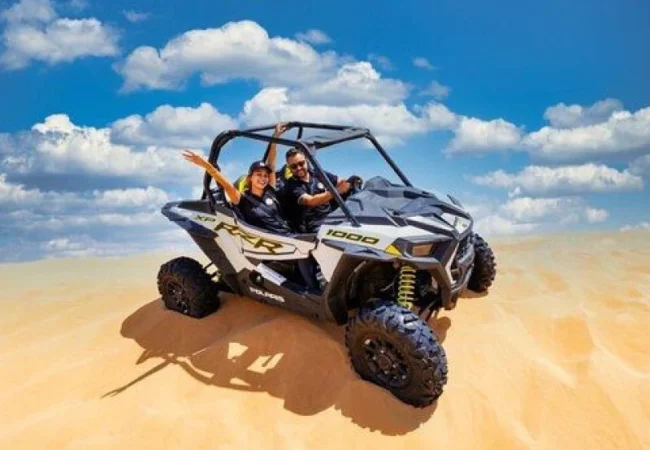
 AED 599
Polaris RZR 1000 — 2 seater
- 2 seats
- 1000cc
- Beginner friendly
The natural starting point. Enough torque to climb a face properly, calm enough that you are not still wrestling it ten minutes in.
Book this buggy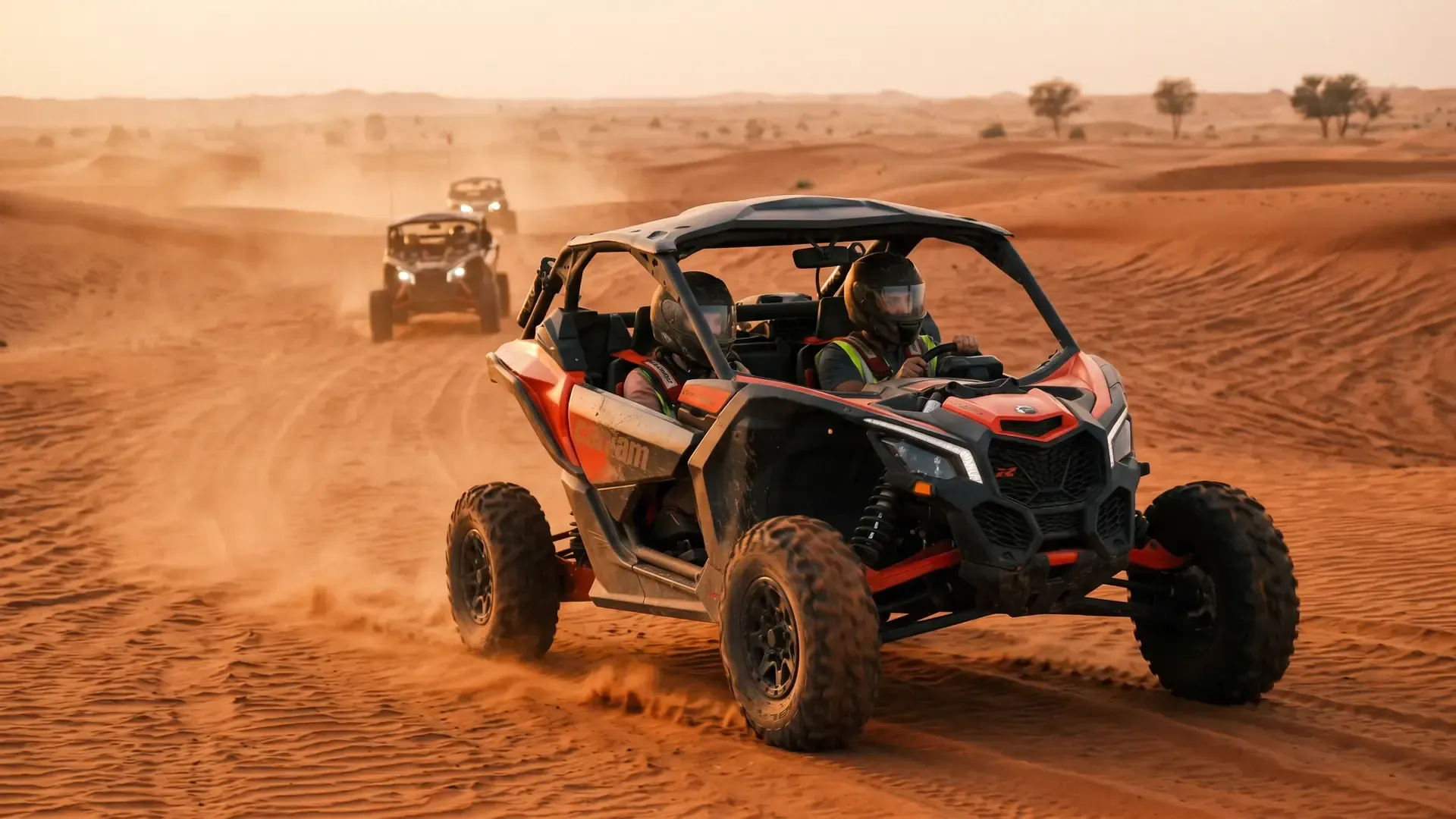
The skyline gets the postcards and the coast gets the brochures, but the red desert past Al Lahbab is the part of Dubai that looks like nothing else in the country. A buggy is how you get into that landscape rather than just past it — choose a Polaris or a Can-Am, tuck in behind the lead guide once the warm-up circuit is done, and drive the dunes yourself instead of watching them slide past a Land Cruiser window.
You steer this one yourself, on the red dune country at Al Lahbab, roughly 45 minutes southeast of Downtown. The scale starts with a 30-minute Polaris RZR session at AED 599 and rises across nine machines to AED 1,400 for the four-seat Can-Am X3 RS Turbo RR. Each session comes with a fitted helmet and goggles, a harness briefing, fuel for the duration and cold water on hand, plus a guide holding the route out front the entire time.
Prices run per buggy rather than per rider, so splitting a 4-seater four ways beats booking two separate 2-seaters on cost alone. Machine, duration and pickup all get nailed down over WhatsApp first, well before any payment is taken.
| Ride | What you get | From |
|---|---|---|
| 30 minutes | A Polaris RZR run through the warm-up circuit and the first dune loop — the shortest way to find out if this is for you. | AED 599 |
| 1 hour | Further into the dune faces past the warm-up bowl, with stops built in for photos. | AED 900 |
| 2 hours | A longer loop through Lahbab's ridgelines, with proper rest stops along the way. | AED 1,750 |
| 3 hours | The full route, reserved for riders who already know how a buggy handles in soft sand. | On request |
| Buggy + BBQ dinner | A buggy session followed by the halal BBQ camp, dinner and transfers included. | AED 2,200 |
A Polaris is the gentler on-ramp: it responds the way you'd expect and rarely punishes a mistake. Can-Am is the step up in power once you have a session or two behind you. Every price shown here is that machine's 30-minute rate.
AED 599
The natural starting point. Enough torque to climb a face properly, calm enough that you are not still wrestling it ten minutes in.
Book this buggy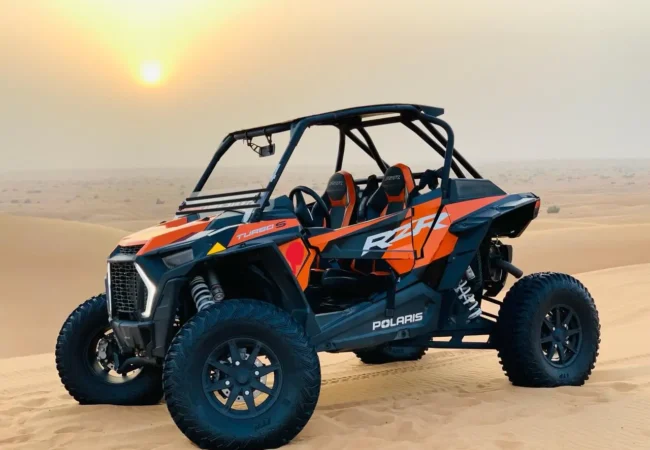 AED 900
Same underlying chassis, noticeably harder pull climbing out of a bowl. What most riders move up to on their second booking.
Book this buggy AED 800
Four harnesses, one driver, one bill — the practical pick for two couples or a family with older kids along.
Book this buggy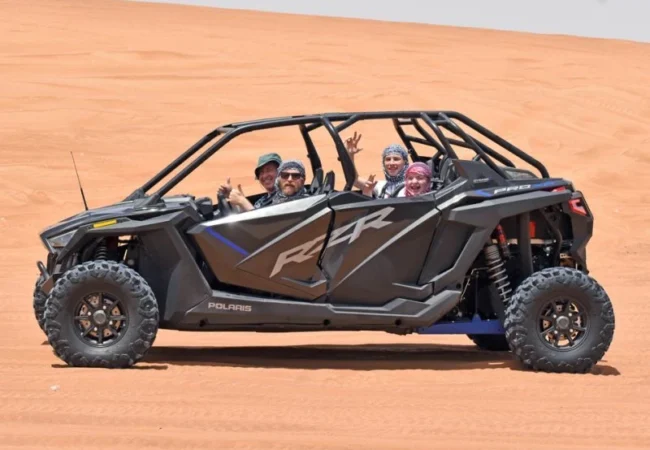 AED 1,200
A full four-seater is a lot of weight to haul up a soft face, and the turbo is what keeps it from stalling out halfway.
Book this buggy AED 999
Sits wider on its frame with far more suspension travel underneath, so rough ground that would jolt a smaller machine barely registers here.
Book this buggy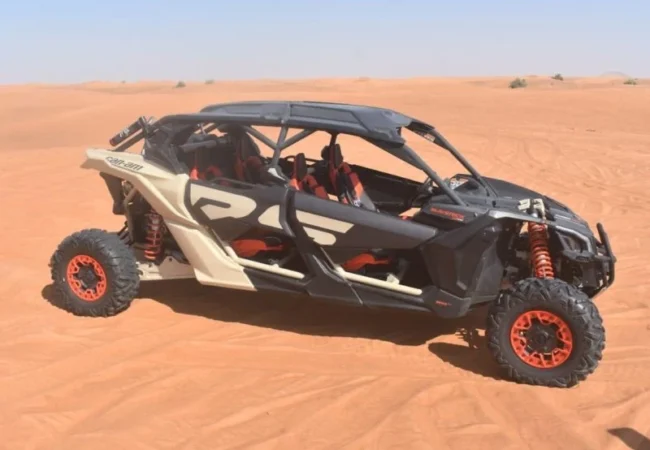 AED 1,200
The same X3 suspension with room for the whole group — friends who all want the sharper car end up here instead of splitting into two.
Book this buggy AED 1,200
Puts 200 horsepower behind suspension travel long enough to make use of it. Ask for this one after a first buggy session, not as your first.
Book this buggy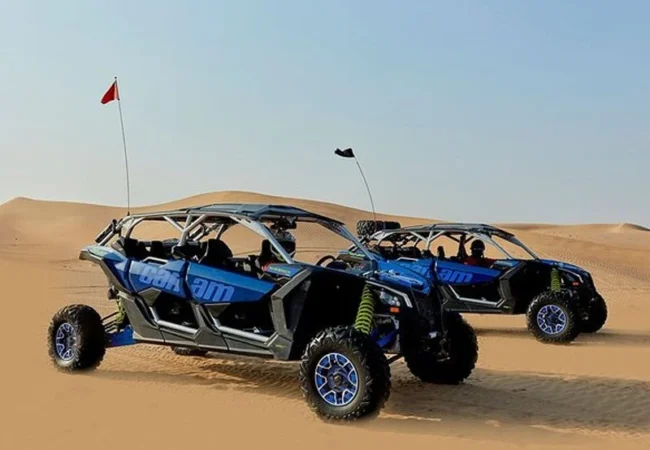 AED 1,400
Nothing else on the fleet crosses a ridgeline this fast with four people aboard. There is only one, and it rarely survives past Friday morning unbooked.
Book this buggy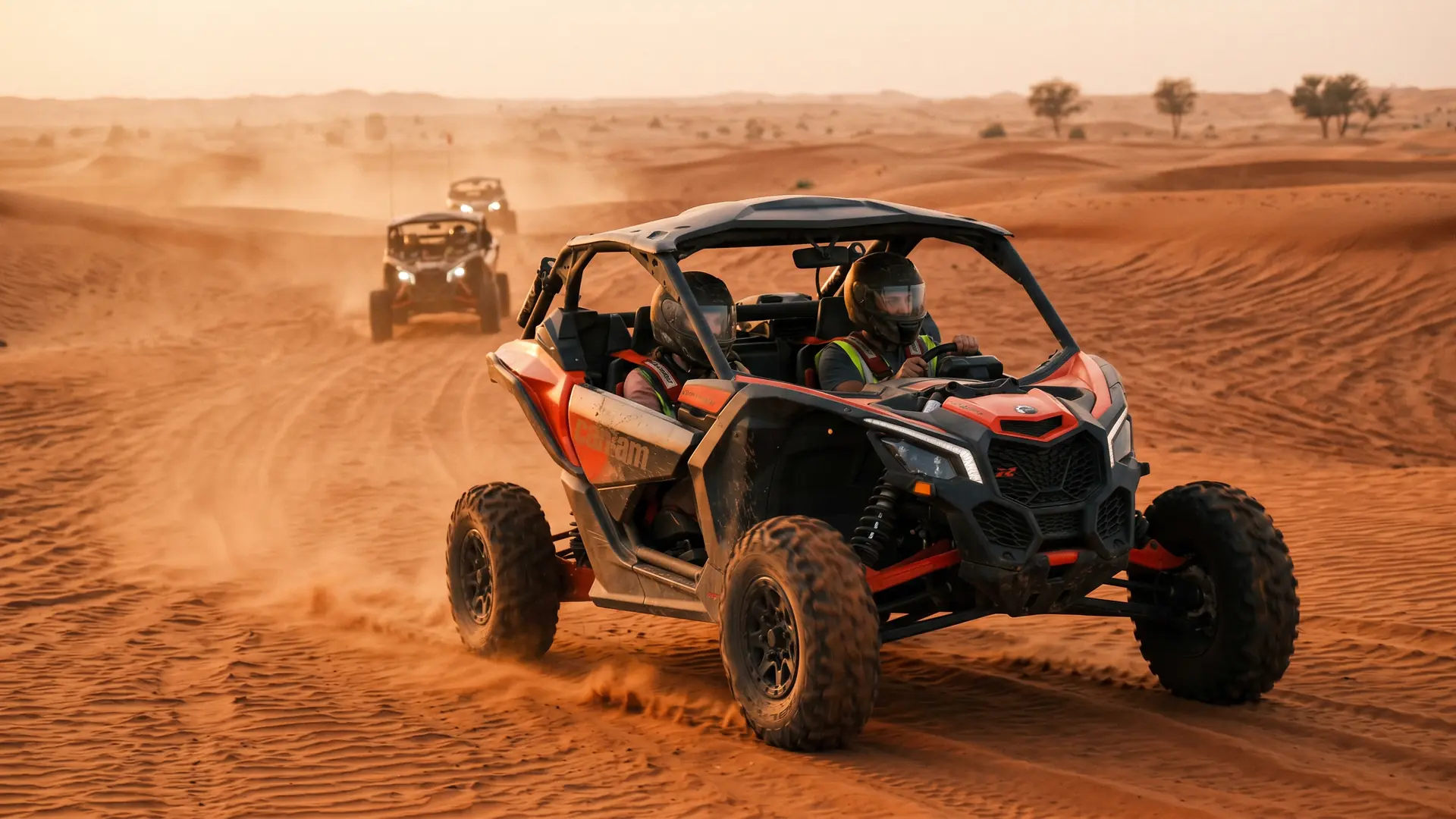 On request
The one that comes up in conversation long before anyone checks the price. Numbers are limited, cost gets settled on the day, and it goes to drivers who have already handled the X3 well.
Ask for a quoteEach of these folds a buggy session straight into the camp evening that follows — dinner cooked halal, the usual entertainment around the fire, and transport handled both directions. One price covers the whole group rather than each rider separately.
 AED 2,200
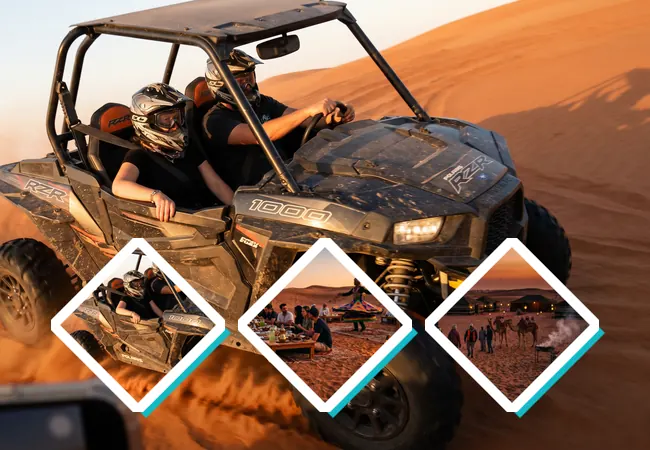
The entry-level combo. A buggy session while the light is still good, then straight on to camp before the sun goes.
Book this combo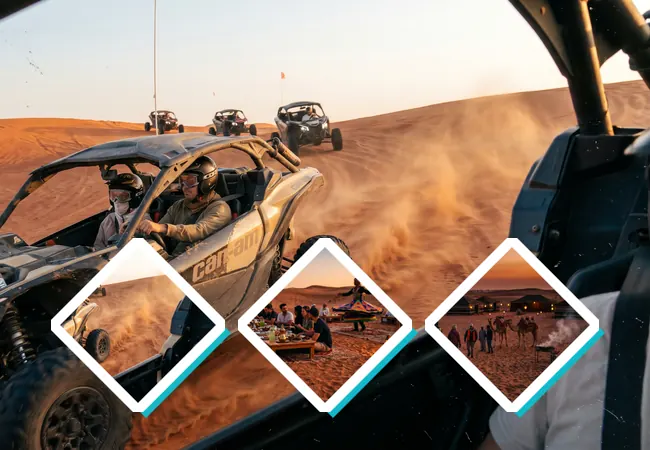 AED 2,799
Same evening, sharper car. Worth the difference if the dunes are why you booked and dinner is really the add-on.
Book this combo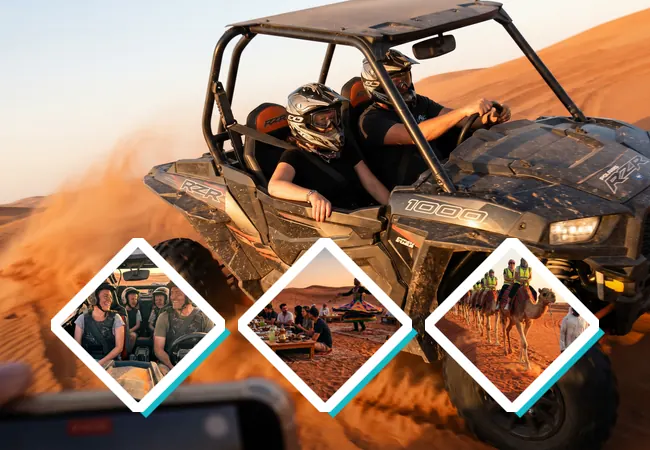 AED 3,200
Everyone in one buggy, everyone at one table after. The default choice for families who would rather not split across two vehicles.
Book this combo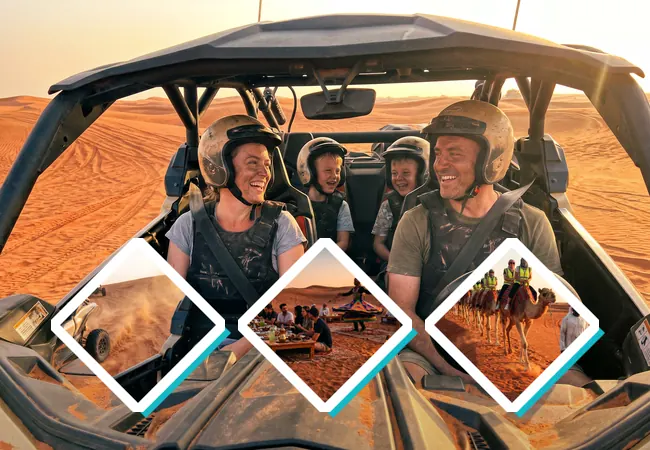 AED 3,950
The full lineup: all four of you in the wider Can-Am, camp dinner waiting afterward. Weekend dates on this one go quickest.
Book this combo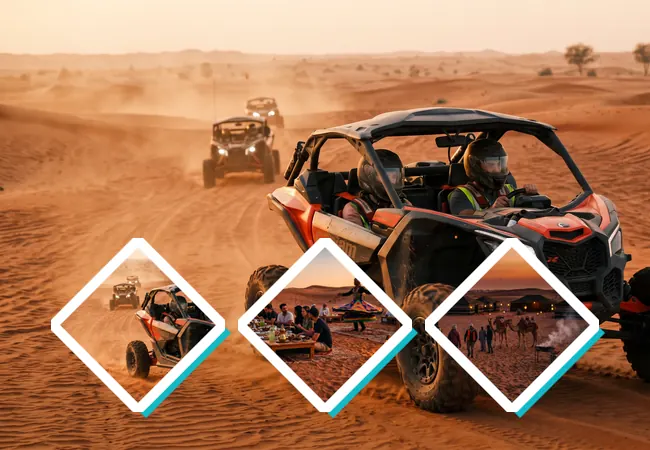 On request
Pairs the range-topping Maverick R with the same camp evening. Confirmed by hand rather than instantly, since the fleet holds just the one.
Ask for a quoteThis decision is smaller than it feels. It comes down to headcount and how many people in your group actually want a turn steering.
Relevant only once sand driving is already familiar to you. First-timers can skip straight past this one.
The identical Al Lahbab base and the identical guides run this, only now it is one rider to a machine rather than a shared cabin. Cost sits well under a buggy, and no small number of visitors book both back to back — quad while the arms are still fresh, buggy once they have loosened up.

Ages 9 to 12 only, on a supervised track, with a guardian required on site.
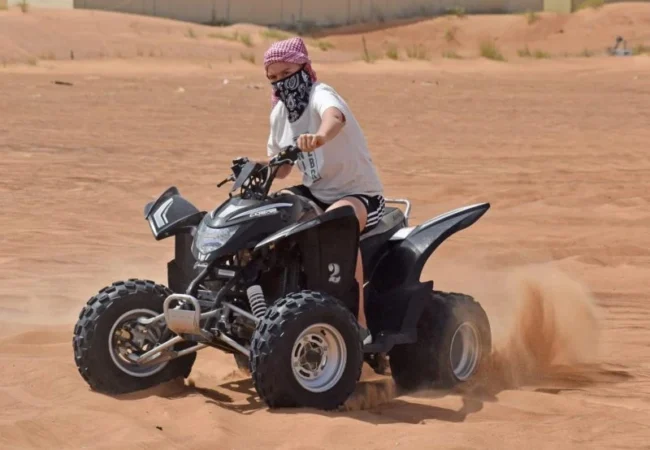
Where most adults start out. Playful enough to be worth the trip, mild enough that nothing about it startles a first-timer.

The quad most people end up on. A turbo version of the same machine goes for AED 350.
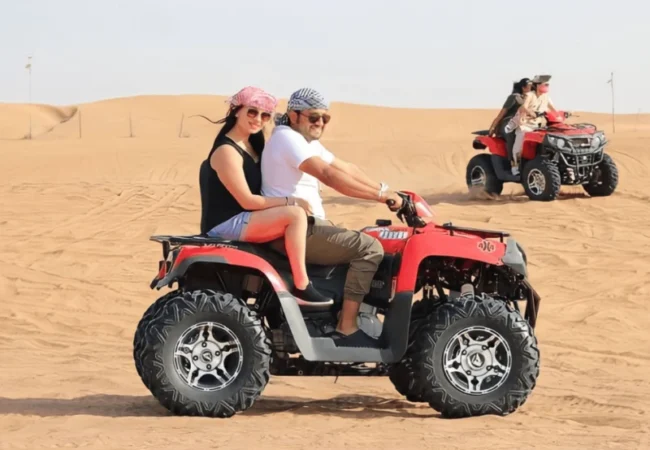
A two-up seat — one person drives, the other rides along, and nobody sits this one out.
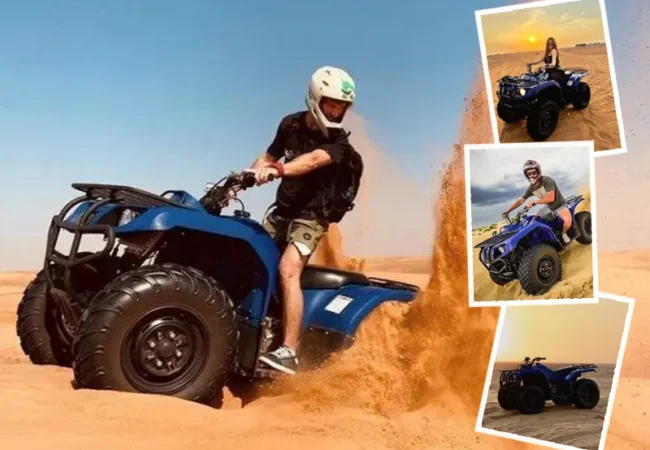
Carries more weight in the frame, which pays off once the ground gets rougher or the route drags on.
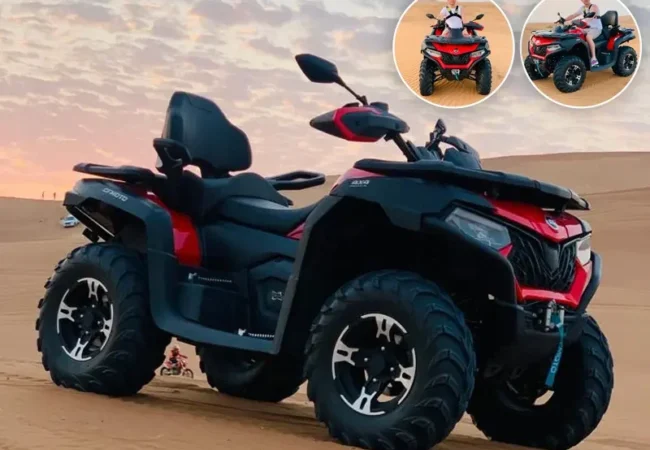
Trims the weight down and sharpens the handling compared with the Grizzly, aimed at riders past their first few outings.

The top of the quad range, and riders get checked out before this one is handed over.
Of everything here, the dirt bikes are the one booking that starts with a conversation instead of a straight yes. Sand punishes poor technique on two wheels in a way a quad simply absorbs for you. Sessions open at an hour for AED 850, stretching to AED 1,250 across two.
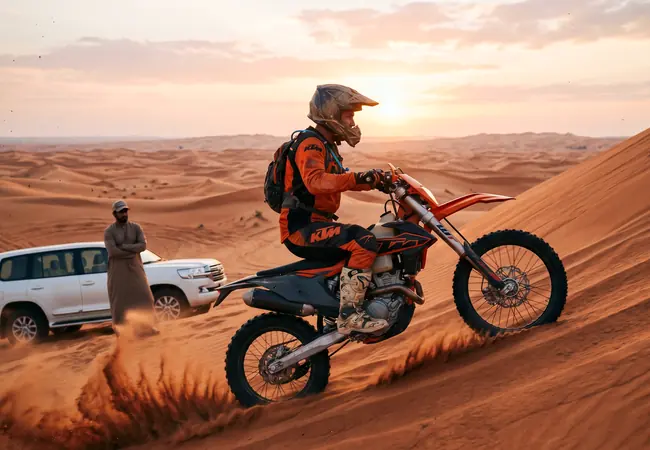
AED 850 buys an hour solo, AED 1,250 covers two, and it only goes out to riders who already have real off-road time logged.
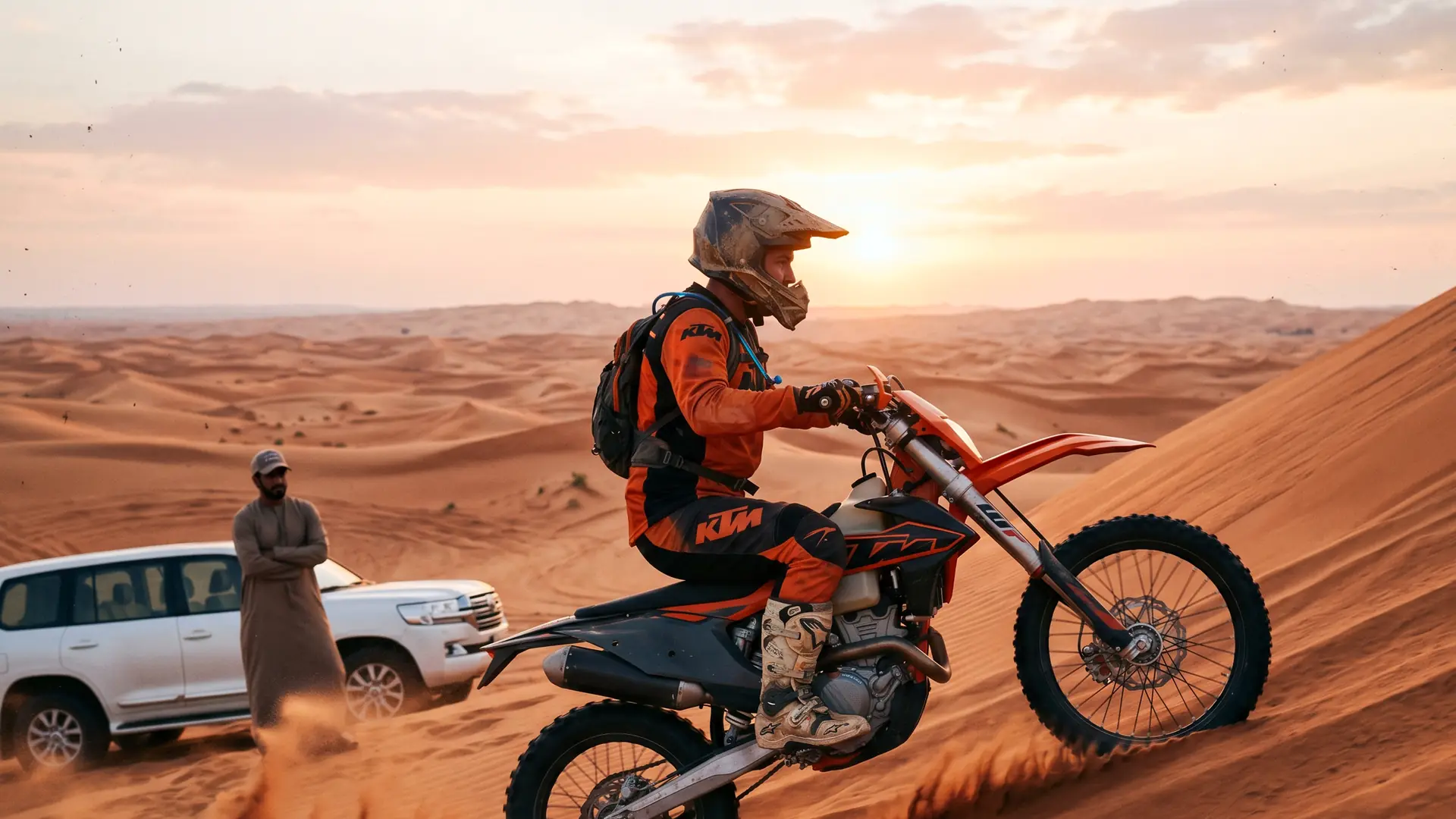
Kept for the advanced line and only released once a guide has watched you ride. Cost gets settled on the day.
Land Cruiser safaris from AED 225, for anyone who would rather watch the dunes go by than steer through them. Most bookings here end up mixed — half the group takes a buggy, the other half takes dune bashing and dinner.
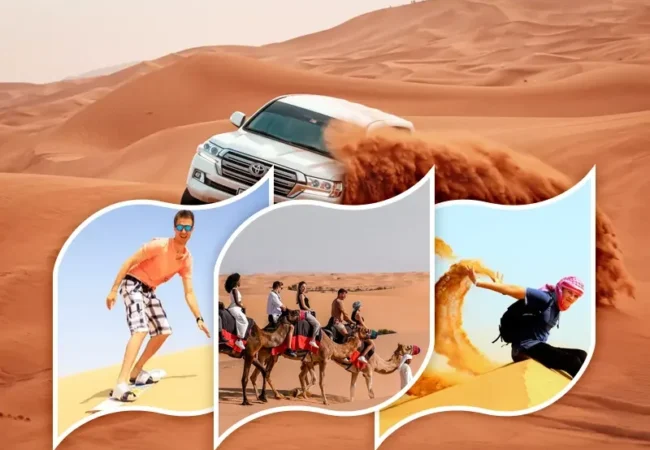
Collection while the air is still cool, with the whole rest of your day still ahead once you are dropped back.

Dune bashing timed for sunset, then the camp evening — halal BBQ and transfers both ways are built into the price.
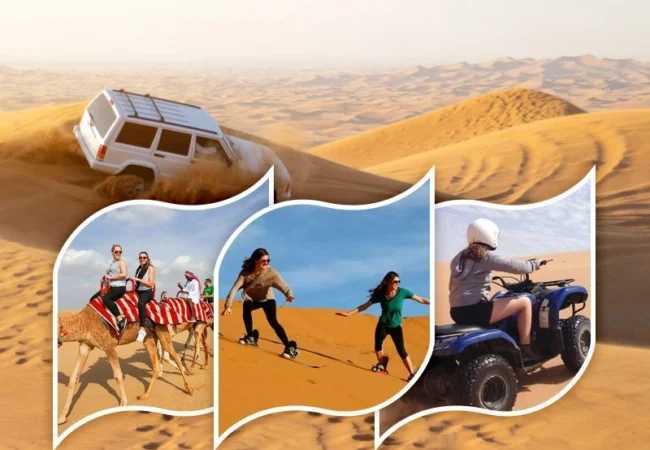
The morning safari run with a quad session folded into the same outing.
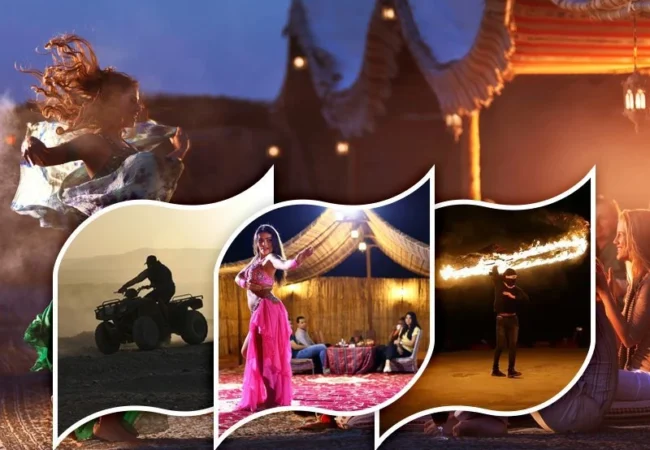
The one most people end up booking. Quad session, sunset dune bashing and dinner at camp, all in one evening.
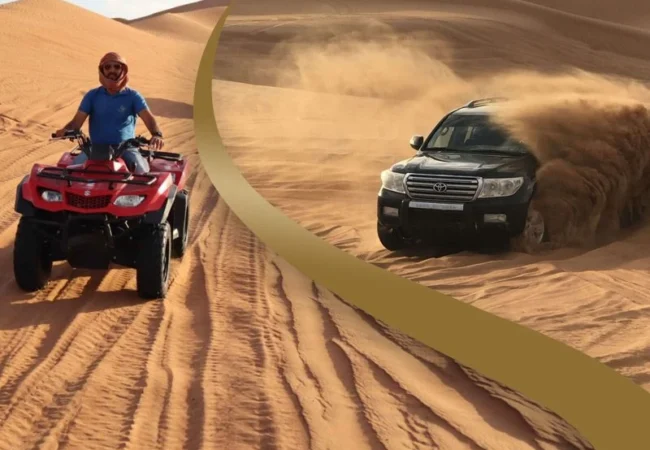
Your group gets its own Land Cruiser and its own driver, so there is nobody else's schedule to work around.

Your own 4x4 and your own pace out to the dunes, finishing with dinner once you reach camp.
Plenty else exists beyond this printed list: overnight camping under open sky, a VIP-grade safari step-up, corporate group rates, family-sized packages, and a calmer alternative that leaves the 4x4 dune bashing out altogether for anyone whose stomach has already voted no on that. One WhatsApp message is all it takes to shape a day around your exact group.
Collection lands around 4:30 AM, which feels brutal right up until you are airborne and watching the dune field turn gold beneath you. Flights need calm weather to go ahead, so they are offered only across the cooler part of the calendar, September into May.
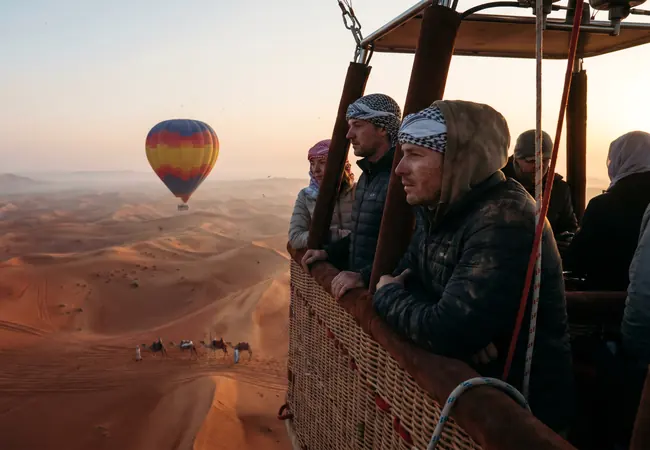
Standard opens at AED 1,049. Step up to AED 1,149 for a falconry display, or AED 1,349 for a full breakfast once you are back on the ground.
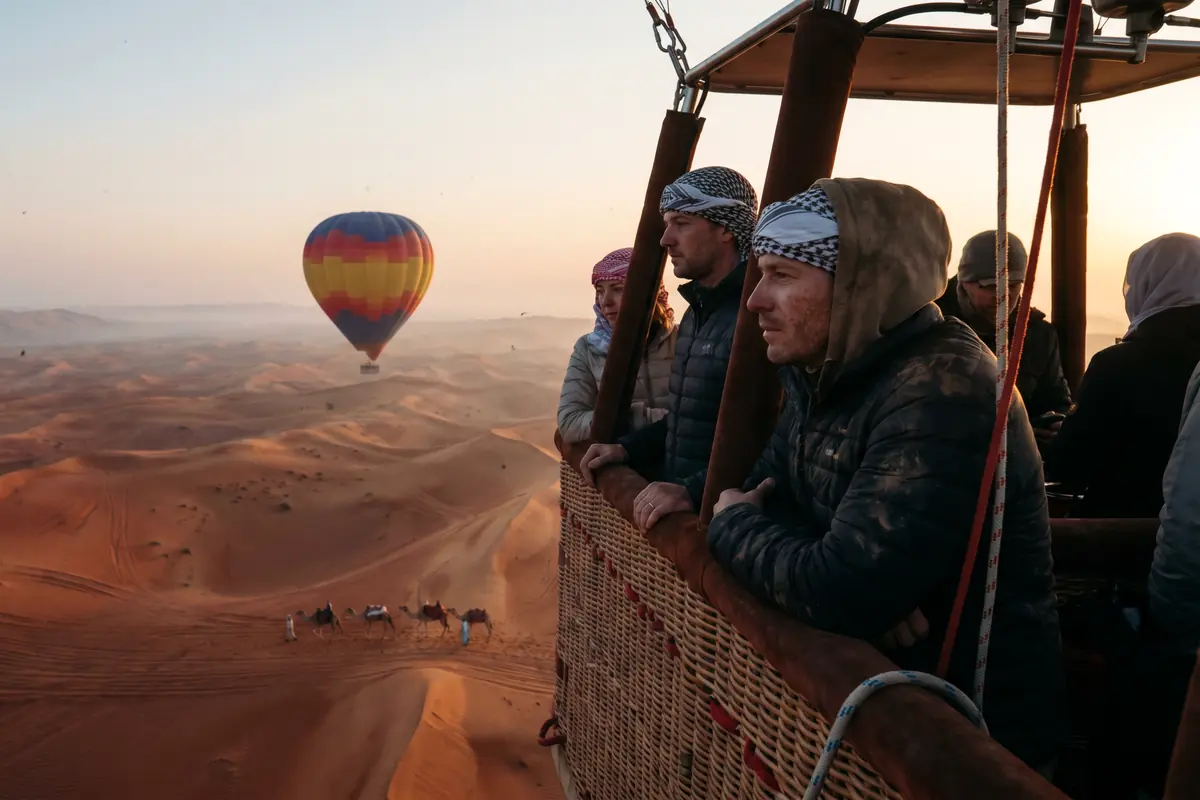
The entire balloon reserved for your group — proposals, anniversaries and corporate outings book this one.
The right add-on whenever small kids, grandparents, or anyone eyeing a buggy with visible doubt happens to be part of the group.
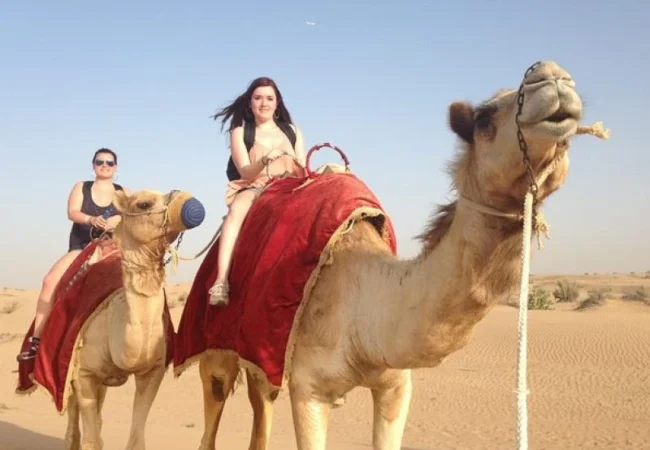
Riding at walking pace over the same rust-coloured ground the buggies cover, welcoming anyone from age 3 with an adult close by.
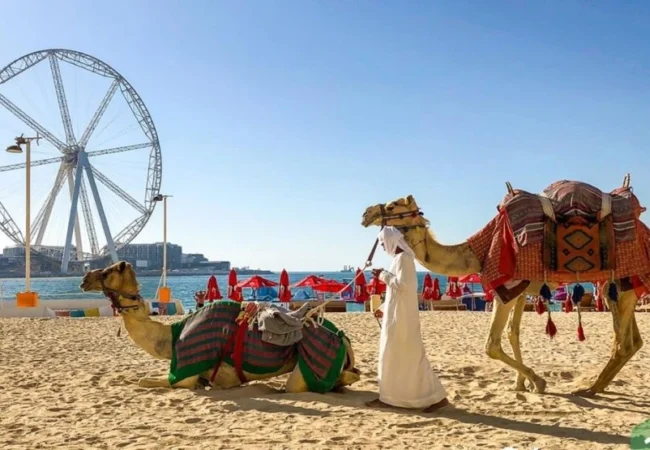
No trip out to the desert needed for this one — it runs right on the JBR shoreline, and it is the photo almost every visitor asks for.
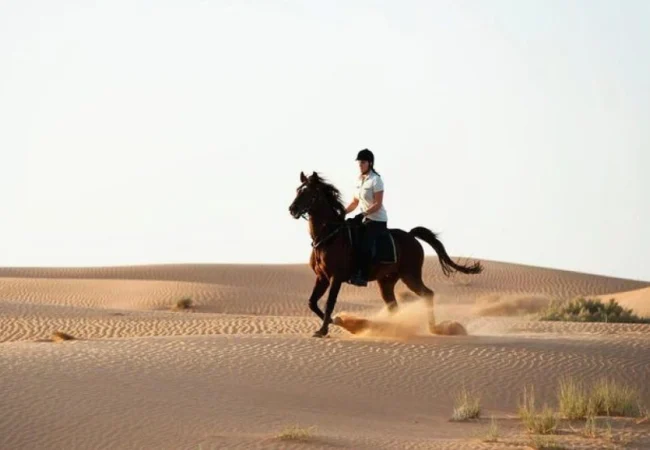
A trail outing with a guide alongside, more comfortable if you have spent time in a saddle before.
There is no set menu of prices here — the final number moves with three things: how many of you there are, which machines end up chosen, and the overall shape of the day. Lay those details out over WhatsApp and a number typically comes back within hours.
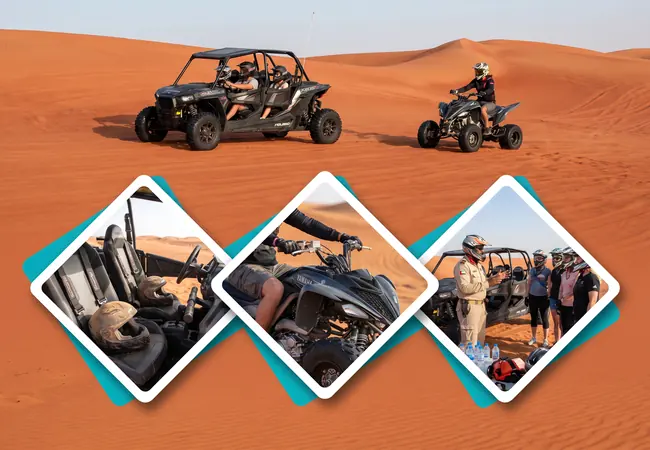
Quad first, buggy after. The two machines you pick decide the final bill, most pairings landing between AED 290 and AED 1,100.
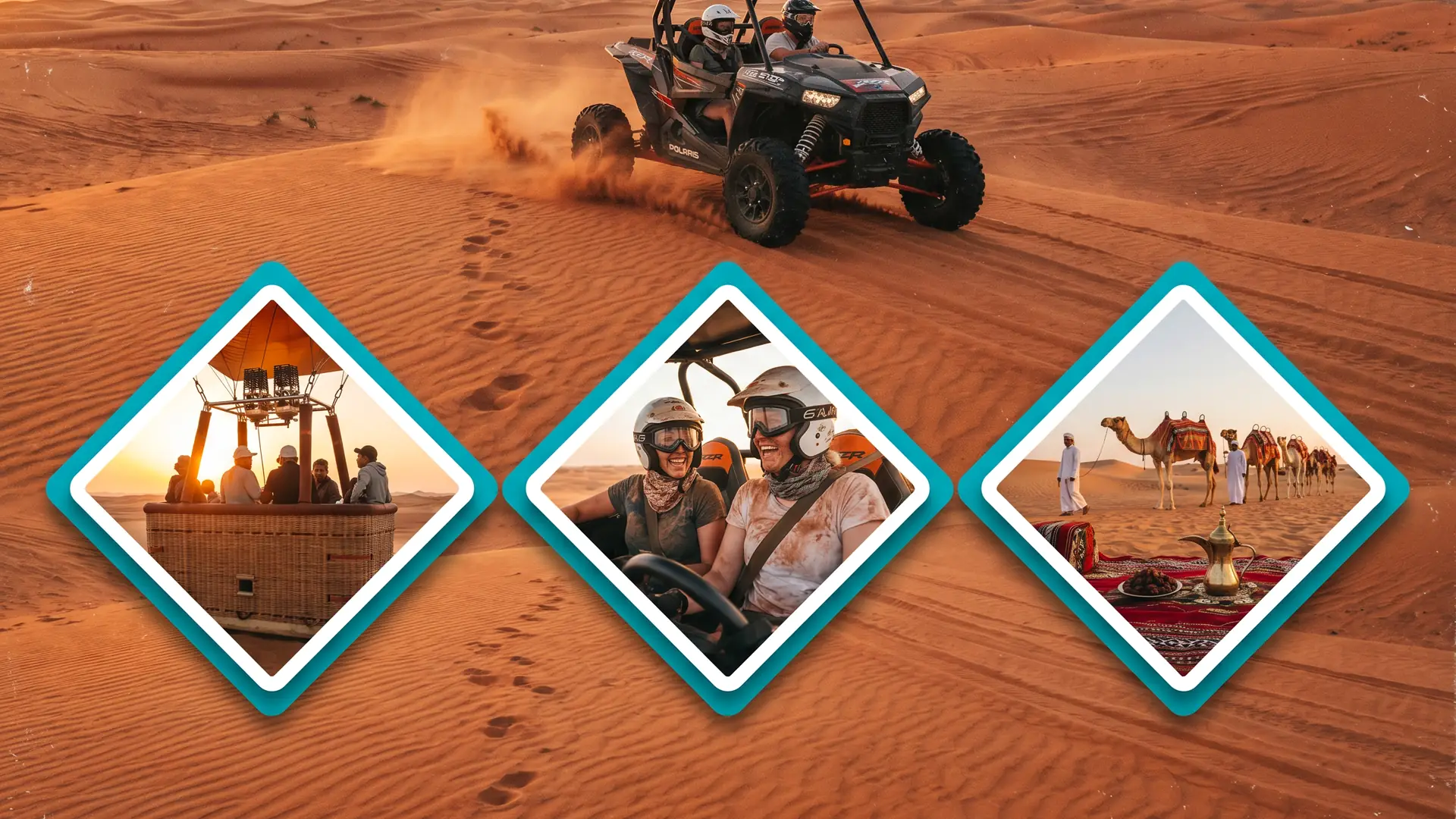
Airborne at sunrise, then back on the ground and into the dunes once the light has properly settled in. A long day, and usually the one people remember most.
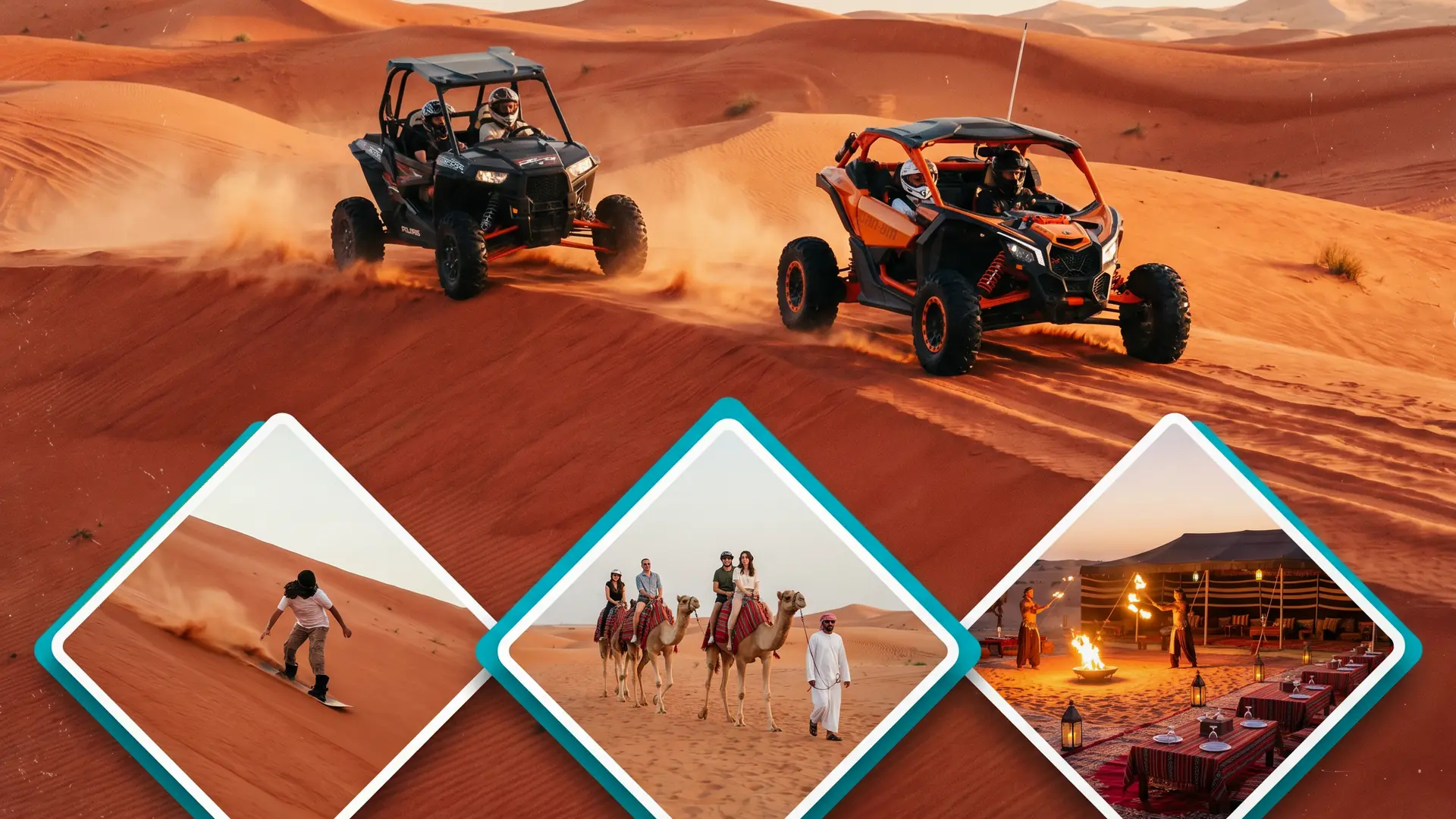
Settles a split group without an argument — the thrill-seekers get their machine, the rest get their slower, quieter version of the same sand.
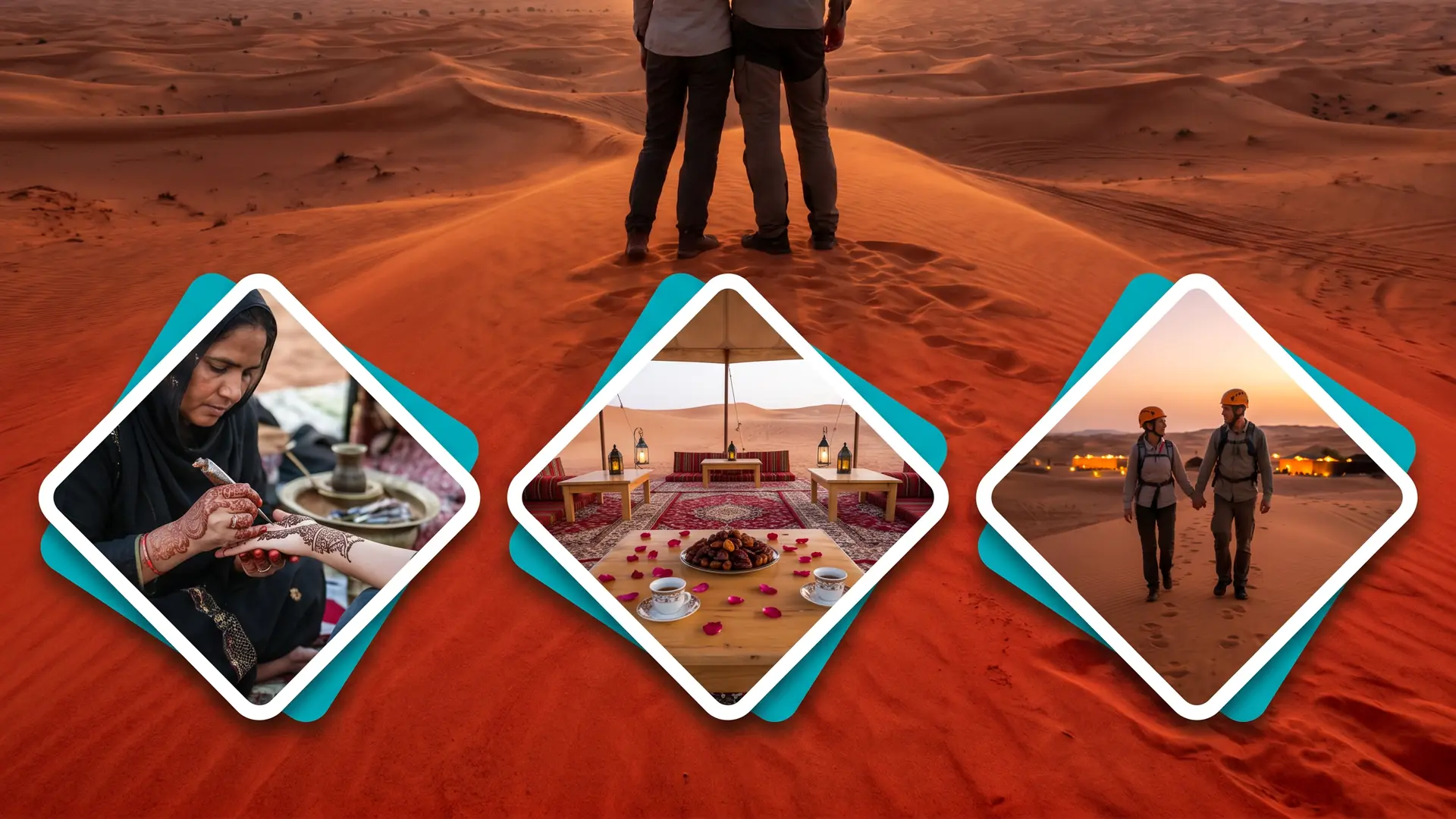
Just the two of you on the route and at dinner afterward, with no other group sharing the vehicle.
Larger builds happen regularly too — an adventure-day lineup that folds in the buggy, a quad, a safari and BBQ together, or a complete version that adds the balloon flight on top of all four. Each gets priced against your own group.
Every buggy, quad and dirt bike here shares one base at Al Lahbab, tucked past the southeastern fringe of the city along the route toward Al Ain. It is the rust-coloured sand behind the photos everyone recognizes, and reaching it eats up close to three-quarters of an hour once ordinary traffic is factored in.
Everyone circles a flat practice patch before the real route opens up. Watching that circuit is how the guide judges how much dune to hand you next, and that judgment call is what keeps the session safe without flattening the fun out of it.
Nothing here catches anyone off guard once they arrive. A 30-minute entry ride and a three-hour booking follow the identical sequence — the middle step is simply the one that grows.
Collected from a central Dubai hotel, or sent directions to drive yourself once the booking is confirmed.
Helmet and harness fitted first, then a walk-through of the controls: kill switch, throttle, and how the lead guide signals along a dune line.
Flat ground before anything else. The guide confirms you can handle the machine before pointing you at anything steep.
Out through the Lahbab bowls and ridgelines behind the lead guide, with stops along the way for photos.
Water, a breather and a first look at the photos back at base, before either your ride home or straight into whatever combo you booked.
Combo bookings continue on to the halal BBQ camp from here, no separate transfer needed.
Children can ride along as passengers while an adult drives, and the 90cc has its own supervised loop set aside for nine-to-twelve-year-olds with a guardian close by. Unsure if one of these exclusions applies to someone in your group? Flag it before payment rather than at the briefing table. Dream Land Adventure Tourism holds a DTCM licence, and out on the dunes themselves, the guides are the ones who call it.
Based on 1,428 Google reviews
Based on 892 reviews
Thirty minutes on the entry-level Polaris RZR 2-seater starts at AED 599, and the scale runs up to AED 1,400 for the same half hour in the 4-seat Can-Am X3 RS Turbo RR. AED 900 covers a full hour, AED 1,750 covers two. Rates are set per buggy rather than per rider, so a full 4-seater works out cheapest per person.
No licence required — every session runs on privately leased land at Al Lahbab, well away from any public road. The real requirement is physical: you need to be large enough and coordinated enough to work the controls comfortably, and the guide judges that during the warm-up loop before anyone reaches a real dune.
At Al Lahbab, off the Dubai-Al Ain road, roughly 45 minutes southeast of Downtown in ordinary traffic. That drive is what buys you genuine rust-red dune country instead of the flattened, well-trodden sand sitting closer to the city limits.
You drive — that is the entire premise, and what separates a buggy booking from a desert safari, where a professional sits behind the wheel of the Land Cruiser and you are simply along for it. A lead guide still sets the route and rides out front of the group, but the throttle stays in your hands the whole way.
Mainly seating and price. Two riders who each want a turn steering are better off in the 2-seater. Three or four on a single booking suits the 4-seater, usually cheaper per head than splitting into separate buggies. A full 4-seater does climb soft dune faces more slowly, so four adults together should look at the turbo version instead.
Yes, riding as a passenger next to an adult who is driving, and a guardian needs to be on site. When a child wants to be the one steering instead, ages 9 through 12 can take the Yamaha 90cc out on its own supervised loop.
No — pickup is billed separately and agreed with you ahead of payment. Driving yourself out is straightforward too; directions to the meeting point are sent as soon as your booking is confirmed.
Clothes you will not mourn afterward — closed-toe shoes, sunglasses, nothing precious. Helmet and goggles are provided on site. Bring a change of outfit for later as well, since sand works its way into every seam regardless of how careful you are.
Polaris suits a first buggy — predictable and easy to read, so the session gets spent enjoying it rather than fighting it. Reach for a Can-Am on a repeat visit, once sand no longer feels unfamiliar underneath you; its extra chassis width and longer-travel suspension let the X3 shrug off rough ground far better.
Thirty minutes works as a taster, enough to tell you whether this is for you. Most people settle on an hour once they know. Two hours is where ridgelines and genuine rest stops enter the picture. Save three hours for a stage where soft sand no longer catches you off guard.
Yes — the buggy and BBQ dinner combos start at AED 2,200 and roll the drive, the camp dinner and both transfers into one price. A quad session, a camel ride or a full safari can join the same day too, with anything combined quoted per group.
Trips from other emirates get arranged case by case and priced ahead of payment. Given how much extra driving is involved, pairing that pickup with a longer session or a stacked adventure day makes more sense than booking it against a single 30-minute ride. Message your pickup point on WhatsApp and expect a clear number back on both cost and timing.
A sandstorm or a heavy gust gets a session rescheduled rather than scrapped. You would hear from the team beforehand with a replacement time to pick from, and moving the slot never adds a charge. Of everything on offer, the balloon flights answer to the weather most closely.
A weekday slot is usually easy inside a few days' notice. Weekends sell through faster, so give it a week or longer if your heart is set on a 4-seater or the X3 RS Turbo RR, since those two are the first to disappear off the schedule. Once a slot is confirmed, it means the online payment securing it has already cleared.
Dubai's desert is not a detour from the city, it is one of the reasons to visit it — a genuine geographic feature sitting less than an hour from the skyline, and Al Lahbab is where its red dunes are at their most dramatic. The most direct way into that landscape is a self-drive buggy: a 30-minute Polaris RZR entry runs AED 599, climbing to AED 1,400 for the Can-Am X3 RS Turbo RR four-seater, with an hour from AED 900 and two hours from AED 1,750. The same stretch of desert also carries quads from AED 150, KTM dirt bikes from AED 850, Land Cruiser safaris from AED 225, sunrise balloon flights from AED 1,049, and camel treks from AED 150.
More first-time visitors land on the Evening Safari + Quad + BBQ at AED 375 than on anything else here, largely because it puts you on the sand at the hour this landscape looks its best and hands you dinner right after. Secure online advance payment confirms your booking, support available 24/7.
Sunset dune bashing, a quad session and halal BBQ dinner, bundled into one evening.
AED 375A Polaris RZR through the warm-up loop and into the first dune line.
AED 599Four harnesses, one driver, one bill — the way most families end up doing this.
AED 800200 horsepower and the suspension travel to use it, for riders who have driven in sand before.
AED 1,400The whole dune field laid out beneath you as the sky changes colour.
AED 1,049Dune bashing while the sand is still firm from overnight, done before the heat sets in.
AED 225Your own Land Cruiser and route, finishing at camp for dinner.
AED 1,400A trek across the same red sand at walking pace, ages 3 and up.
AED 150Yes, both geographically and touristically. Dubai sits at the edge of a vast sand sea that stretches deep into the Arabian Peninsula, and the red dune country at Al Lahbab is as much a defining feature of the emirate as the Burj Khalifa or the Jumeirah coastline, just less photographed by people who never leave the city.
Dubai's global image runs almost entirely through two pictures: a skyline racing upward out of nothing, and a strip of coastline dotted with resorts. Both are real, and both are worth seeing. Left off that shortlist more often than it should be is the third landscape that actually explains why the other two exist where they do — the desert pressing against the city's southern and eastern edges, a genuine extension of the Arabian interior rather than a manufactured backdrop. Every road heading that way eventually runs out of buildings and into sand, and it happens faster than most first-time visitors expect.
What makes it a defining feature rather than just empty land nearby is the specific geology. Much of the sand within easy reach of the city is pale and compacted, shaped more by decades of vehicle traffic than by wind. Out at Al Lahbab, roughly 45 minutes past the edge of the built-up city, the sand carries genuine iron-oxide colouring and has been left alone long enough to build into proper dunes — ridgelines, bowls, standing faces that run several storeys high in places. That colour and that shape are what people actually mean when they picture "the Dubai desert," and it is a specific, real place with its own geography worth knowing before you go, covered in full at where we ride.
Put the three landmarks side by side and the desert arguably has the longest claim to the title. The skyline is a few decades old. The coastline has been substantially reshaped by land reclamation within living memory. The dune country at Al Lahbab looked roughly the way it looks now well before either of the other two existed, and will likely still look that way once most of what is currently under construction has been renovated at least once. That is not a knock on the skyline or the coast, both are genuinely worth the visit, it is simply a case for treating the desert as a peer attraction rather than an optional add-on squeezed into a spare afternoon.
Most people picture a single, dramatic wall of orange sand, usually mid-dune-bash, usually at sunset, usually with a Land Cruiser catching air off a crest. Al Lahbab is close to that image on a good evening, but the everyday reality is quieter, wider and more varied than any one photo can show.
Ask someone who has never been to Dubai to picture its desert and the answer is fairly consistent: a single steep dune, glowing orange-red, probably at golden hour, with a 4x4 mid-turn on the face of it and a plume of sand behind the wheels. That image is not wrong exactly, it is a compressed highlight-reel version of one specific moment, built almost entirely from marketing photography and a handful of viral clips rather than from what a typical few hours out there actually looks like.
The reality at Al Lahbab is both bigger and calmer than that mental picture. It is not one dune, it is a rolling field of them, running a long way in every direction, with flat interdune stretches, low scrub in places, and colour that shifts constantly with the angle of the light rather than sitting fixed at postcard-orange. A dune-bashing highlight genuinely is part of what happens out there, particularly on the Land Cruiser safaris, but it is a few dramatic minutes inside a much longer, quieter stretch of driving, walking or riding across open ground.
The gap between the mental picture and the place itself is mostly a matter of pacing, not accuracy. The photo shows the one dramatic second; it says nothing about the twenty quiet minutes on either side of it, or the fact that most of any visit, on a buggy, in a safari vehicle, on a camel, is spent moving steadily across open sand rather than launching off crests. Knowing that in advance tends to make the trip land better, not worse. Visitors expecting non-stop, trailer-reel action for the full booking sometimes come away oddly flat; visitors who understand it as a landscape to move through, with a handful of genuinely dramatic moments inside it, tend to describe it afterward as the best part of their trip.
For most itineraries, yes. A half-day slot is enough to get a genuine sense of the landscape, and the drive time out is shorter than the ferry crossing or day-trip transfer that similar "signature landscape" excursions require in most other major cities.
Dubai trips are frequently short: a stopover, a long weekend bolted onto a business trip, three or four days squeezed between flights. On a schedule like that, every half-day carries a real opportunity cost, and it is a fair question whether the desert earns its slot against the Burj Khalifa, the souks, the malls and the beach clubs already competing for the same hours.
The practical case holds up well. Getting from a Downtown or Marina hotel to Al Lahbab and back, with a genuine activity in between, fits comfortably into a morning or an evening rather than swallowing an entire day — see combo packages for how a buggy, a safari or a balloon flight slots around the rest of a trip. That is a shorter total time commitment than the desert excursions attached to plenty of other major cities, where the "real" version of the landscape sits hours away rather than 45 minutes.
The stronger argument is about what the desert offers that nothing else on a Dubai itinerary does. The skyline, the malls and most of the beach clubs are, at their core, expressions of the same modern building boom, however different they look from one another; the desert is the one landscape that predates all of it and looks nothing like the phone screensaver of Dubai everyone has already seen a hundred times. If the trip genuinely comes down to one free afternoon against something non-negotiable, treat the desert as the one to shorten rather than cut — a 30-minute buggy entry, a morning safari or a sunrise balloon still delivers the core of the landscape without a dedicated day.
Different palette, different terrain, different access. The colour runs redder than the pale Sahara sand most travellers picture by default, the dunes are steeper and more concentrated than the flatter stretches near many other desert cities, and nowhere else puts a genuine dune sea within a 45-minute drive of a global airport hub.
Visitors arrive with wildly different reference points. Some have crossed the Sahara on an overland trip. Some have seen the pale dunes outside Merzouga or the Empty Quarter's more remote stretches on a documentary. Some have never stood on open sand at all, and their only comparison is a beach. All of those reference points are useful, and none of them quite prepares a person for what Al Lahbab actually looks like.
The most obvious difference is colour. Plenty of the world's famous deserts run pale gold or bleached white; Al Lahbab's sand carries a genuine rust-red cast from iron oxide in the grain, closer in tone to parts of the American Southwest or Australia's Red Centre than to the Sahara most people picture by default. The second difference is scale and access. Deserts like the Empty Quarter or the deeper Sahara are enormous and, for most travellers, genuinely remote — a serious expedition rather than an afternoon out. Al Lahbab is a fraction of that size and sits closer to a major international airport than almost any comparable dune landscape on the planet, which changes what the visit can reasonably be: not an expedition, but a proper landscape experience folded into a half-day.
What holds up well against any comparison is the dune shape itself. Because the sand at Al Lahbab has been left alone rather than flattened by decades of traffic, it piles into genuine bowls, ridgelines and standing faces rather than the low, worn humps found on plenty of easier-access desert fringes elsewhere. Riders and drivers who have handled dunes in North Africa or the Gulf's other emirates tend to say the terrain here compares fairly against places that took a full day or more to reach, which is a meaningful compliment given how short this trip out actually is. The comparison that falls flat is against the very largest sand seas on Earth — nobody is claiming Al Lahbab rivals the Rub' al Khali in scale — but for a landscape reachable inside an hour of a five-star hotel, this is a genuinely serious dune field, not a token patch of sand kept around for tourist photos. The machines built to actually cross that terrain, rather than just look at it, sit in the fleet section above.
Both, but rarely in equal measure, and which one dominates usually comes down to pace. Faster activities like a buggy session tend to be remembered as an experience with the desert as the setting; slower ones tend to be remembered as the landscape itself, with the activity as the frame around it.
This is less of a trick question than it sounds. Talk to enough people after a desert booking and the answer to "what do you remember" splits fairly cleanly along one line: how fast they were moving. A 200-horsepower buggy session, driven through bowls and ridgelines, tends to get remembered primarily as an adrenaline experience — the machine, the sensation of the climbs, maybe one specific moment of catching a line wrong and correcting it. The desert itself is very much present in that memory, but as the stage the experience happened on rather than as the subject of it.
Slow the pace down and the balance flips. A camel trek across the same red sand, moving at walking pace with nothing mechanical between rider and ground, tends to produce the opposite kind of memory: people describe the quiet, the colour of the light, the shape of one particular dune against the sky, rather than any single dramatic moment. Sunrise balloon flights land somewhere similar. Almost nothing happens, in the activity sense, for the better part of an hour, and that is precisely why passengers come back talking about the view rather than the flight itself.
Neither version is the "right" way to experience the place, and plenty of visitors get both inside a single trip by pairing a fast activity with a slow one. What is worth knowing going in is which kind of memory a given booking is actually built to produce, so the choice matches the trip. Someone chasing a landscape memory who books a flat-out buggy session may come home with excellent photos of a machine and comparatively few of the dunes themselves; someone chasing adrenaline who books only a camel trek is going to leave wanting more. Reading the two honestly against each other before booking saves that mismatch later.
Looking at it from a road pull-off gets you a photo, not an experience. The interesting parts of Al Lahbab sit well back from any public road, inside terrain that genuinely requires either a capable vehicle, a guide, or both, to reach safely.
It is a fair instinct to wonder whether paying for a structured activity is necessary at all, when the whole point is just to see some sand. In plenty of destinations the honest answer would be no — plenty of famous viewpoints sit a short walk from a car park. The desert around Dubai does not really work that way, and the reason is more practical than commercial.
The dune country that actually looks like "the Dubai desert" sits well past the point where a rental sedan can safely go. Loose sand swallows an ordinary road tyre almost immediately, there is no signage or marked trail system out there, and the terrain that photographs best — steep faces, deep bowls — is exactly the terrain that is easiest to get stuck or turned around in without local knowledge. What a guided activity is actually buying is not entertainment layered on top of the view, it is safe, practical access to a landscape that resists casual, unassisted exploring. That holds whether the activity is a buggy session with a lead guide holding the route, or a Land Cruiser safari with a professional driver reading the terrain — the full detail on how that structure works during a session sits in how the session runs.
There is a genuine middle option worth knowing about, though: the drive along the Dubai–Al Ain road passes visibly changing desert scenery the whole way, and the dune at Big Red, a single landmark dune close to the roadside and distinct from the deeper Al Lahbab territory, is viewable without booking anything at all. It is a real, if limited, way to look at desert scenery without a structured activity, and a drive-by look like that satisfies curiosity well enough. What it does not provide is access to the deeper dune field or the safety infrastructure — water, guides, a vehicle built for the terrain — that makes spending real time out there sensible; that access, more than the specific machine attached to it, is what a guided activity is really selling.
As a sight rather than a booking slot, dawn is stillness and pale colour before anyone else arrives, midday is the flattest and least photogenic version of the landscape, and dusk is when the red sand actually looks the way it does in every photo that talked you into coming.
Treat the desert as a piece of scenery rather than a booking slot to optimise, and the time-of-day question turns genuinely interesting rather than merely logistical. The same dune field puts on three quite different shows across a single day, and which one a visitor happens to see shapes the whole impression they walk away with.
Dawn is the quietest version. The light comes in low and pale rather than golden, the sand has not heated up yet, and there is often nobody else in view — the desert at its most stripped-back, more about the stillness and the scale of empty space than about colour. It is the version people on a sunrise balloon flight get to see from above, which arguably suits dawn's character better than a ground-level view does: from a basket, the pale early light and the sheer size of the dune field read as genuinely dramatic in a way that is harder to capture standing on the sand itself.
Midday is, frankly, the least flattering version, and worth knowing about before arriving with expectations set by an evening photo. Direct overhead sun flattens the shadows that give a dune its shape, washes the red toward a duller brown, and makes the whole landscape look flatter than it actually is underfoot. It is the version fewest photographers choose deliberately, and the version most visitors who only pass the desert briefly, mid-journey between other stops, happen to end up seeing.
Dusk is the version that matches the postcard everyone has already seen. Once the sun sits low on the horizon instead of overhead, every ridge throws a long shadow, every dip in the sand reads as genuinely three-dimensional rather than flat, and the ground shifts from a dulled brown toward the deep red that talked most visitors into coming in the first place. It is no accident that the evening safari and BBQ combos are timed for this exact window — dinner happens to land there too, but the scenery is the real reason the slot got chosen. None of it argues for one booking time over another, since plenty of people only have the window they have, but it is worth knowing which version of the landscape a given hour is going to hand you.
Al Lahbab is the main red-dune territory the operators here use, but it is not literally the only desert near Dubai — Big Red sits closer to the road as a single standalone dune, and other emirates have their own desert fringes. For a full, proper red-dune landscape within a short drive of the city, Al Lahbab is the one worth the extra distance; closer alternatives tend to be flatter and more heavily used.
You can drive the public road out that way and see desert scenery through the window, but the dune field itself sits on privately leased land used for the guided sessions, so there is no public walk-in access to the interesting terrain. Seeing it properly means booking one of the activities that operate there.
The dune shapes stay broadly the same, but the general look shifts — greener scrub after rare winter rain, hazier air at the peak of summer, and noticeably different crowds depending on the season. October through April is when the landscape is easiest to enjoy at any hour; summer pushes comfortable viewing to the earlier and later parts of the day.
It rarely feels crowded. Multiple operators run sessions across a wide stretch of dune country, so groups spread out naturally rather than converging on one spot, and a couple of ridgelines are usually enough to put you out of sight of any other vehicle.
Mostly yes for the colour and the dune shapes, less so for the pacing — a good photo captures one dramatic second, not the longer, quieter stretch of ordinary desert around it. Visiting in the right light, generally late afternoon, gets you closest to matching the photos most people see beforehand.
There is more than it looks like from a distance. Hardy desert shrubs and the occasional ghaf tree hold on in the flatter ground between dunes, and animal life — foxes, hares, various birds — tends to show up as tracks in the sand more often than as a direct sighting.
The hot air balloon, without much competition — it is the only vantage point that shows the scale of the whole dune field at once rather than just the section immediately around you. A buggy or safari gets you inside the landscape; a balloon shows you the shape of it.
Plenty of repeat visitors would say it is worth going back, mainly because a single booking only covers one activity, one time of day and one small corner of a much larger dune field. Coming back for a different activity, or the same one at a different hour, genuinely shows a different side of the place.
Both. It is a major draw for first-time visitors, but plenty of Dubai residents treat a desert morning or evening as a regular escape from the city, particularly across the cooler months, which says something about how the landscape holds up beyond a single once-in-a-lifetime visit.
That it is small — a patch of sand kept around for tourist photos rather than a real landscape. Once people are actually out past the first few dune lines, with the city out of sight and open sand running in every direction, that assumption tends to disappear fairly quickly.
Pick your machine and a duration, lock it in with secure online payment, and expect your pickup details over WhatsApp the evening beforehand.